


Ink Preferred vs Ink Cash for Ads

You run Google Ads or Meta on a Chase Ink card and want to know which one should carry the ad bill. This page answers Ink Preferred vs Ink Cash for Ads with one honest split: Ink Business Preferred bonuses social and search advertising, and Ink Business Cash does not. Cash’s famous 5% is for office supply stores and internet, cable, and phone services. It is not an ads rate.
If you searched Ink Preferred vs Ink Cash advertising because you saw “Ink Cash 5%” and assumed it covered ads, this is the correction. It is a two-card head-to-head, not a 10-card list, and not the Preferred vs Amex Business Gold question. That one lives in the Ink vs Amex Business Gold operator stack.
Credit Waypoint is an independent publisher, not a bank or advisor. Disclosure. Fees and categories were read on Chase product pages on October 5, 2026. If the issuer disagrees with this page, the issuer wins.
Rule of thumb. Put social and search advertising (Google Ads, Meta, and similar, when Chase’s advertising language applies) on Ink Business Preferred: 3X inside a combined $150,000 anniversary-year basket it shares with shipping, internet/cable/phone, and travel. Do not put ads on Ink Business Cash expecting 5%. Cash’s 5% covers office supply stores and internet, cable, and phone services on the first $25,000 combined per anniversary year. Ads on Cash earn the base 1%. Hold both when you need Preferred for ads and Cash for office and telecom (plus 2% on gas and dining). Confirm every charge after it posts.
Who this head-to-head is for (and who it isn’t)
It is for founders and operators with real social or search ad spend who are choosing between these two Ink cards, or who already hold both and have no routing rule. It is also for anyone who heard “Ink Cash 5%” and assumed the ad bill was included.
It is not for personal travel maxxing, grocery swipe guides, or Hyatt-transfer shopping. It also isn’t the Preferred vs Amex Business Gold comparison, the software map, the cloud map, or the Google Ads coding deep-dive. Two cards, one bill.
Ink Preferred vs Ink Cash for Ads: the honest split
Myth check. There is no “Ink Cash 5% advertising cap.” Chase’s live Ink Business Cash page bonuses office supply stores and internet, cable, and phone services at 5%, and gas stations and restaurants at 2%. Advertising is not on the page as a bonus category. Ads on Cash earn 1%.
Categories, caps, and fees as of October 5, 2026. Confirm on Chase before you decide.
| Job / factor | Ink Business Preferred | Ink Business Cash | Operator note |
|---|---|---|---|
| Social / search advertising | 3X on advertising purchases made with social media sites and search engines, inside the combined $150,000 3X basket | 1% base. No advertising bonus category | Preferred is the default ads home |
| Office supply stores | 1X (not a Preferred 3X category) | 5% inside the combined $25,000 basket shared with internet, cable, and phone | Cash job |
| Internet, cable, phone | 3X inside the $150,000 combined basket | 5% inside the same $25,000 combined basket as office supply | Cash usually wins until its $25,000 fills; then re-check |
| Gas stations / restaurants | 1X | 2% on the first $25,000 combined per anniversary year | Cash side job, not ads |
| Everything else | 1X | 1% | Neither card bonuses it |
| Annual fee | $95 | $0 | The $95 is what buys the ads 3X |
| Bonus cap clock | First $150,000 combined across shipping, social/search advertising, internet/cable/phone, and travel, per account anniversary year, then 1X | First $25,000 combined for the 5% basket, plus a separate $25,000 combined for the 2% basket, per account anniversary year, then 1% | Different caps. Do not mix them |
| Rewards currency | Ultimate Rewards points | Cash back rewards | Bill routing matters more than currency here |
| Foreign transaction fee | None | 3% of each transaction (Chase Pricing & Terms) | Foreign-billed ad accounts belong on Preferred anyway |
These cards are illustrations only. Holding them is not required.
The one real overlap is internet, cable, and phone. Both cards bonus it, and Cash’s 5% beats Preferred’s 3X on that bill until Cash’s $25,000 combined cap fills. That is a telecom rule. It does not make Cash an advertising card.
Hold both vs one
Use this as a routing frame, not a sales pitch. Run it on your posted categories and real fee math.
| Situation | Lean |
|---|---|
| Heavy social/search ads plus real office supply and/or telecom spend | Both. Ads to Preferred; office supply and telecom to Cash while under its $25,000 combined 5% cap |
| Ads-heavy; little office supply; telecom already earning 3X on Preferred | Preferred only |
| Almost no ads; mostly office supply, telecom, gas, and dining | Cash only. Not really an ads decision, and any ad charges earn 1% |
| Low total volume or categories you cannot confirm yet | A $0 flat-rate catch-all until statements prove the categories (see the ads map). Do not force either bonus card |
How we picked
- We compare the ad-bill job first, then what Cash’s 5% and 2% baskets actually cover. This is not a universal “best Ink.”
- Issuer-stated category language comes first: the Preferred product page and the Cash product page, read the day we wrote this.
- The annual fee only matters if ad volume, plus any other Preferred 3X spend you really have, clears $95 against Cash’s $0.
- Signup bonuses change short-term math and then expire. Do not build a standing routing rule on an offer. See signup bonuses you can actually clear.
- Full rulebook: How we compare.
When this is wrong
This head-to-head is wrong for you, or you are using it wrong, if any of these is true:
- You put Google or Meta ads on Cash expecting 5%. They earn 1%. On $5,000 a month of ads, that gap is real money every month.
- You treat Cash’s internet, cable, and phone 5% as an advertising category. It is a telecom category. Ad platforms are not phone companies.
- You ignore Preferred’s $150,000 combined cap. Ads share that basket with shipping, telecom, and travel. Past the cap, everything drops to 1X.
- You ignore Cash’s $25,000 combined cap. Office supply and telecom share one 5% bucket per anniversary year.
- Your real question is ads plus software. Then compare Preferred with Amex Business Gold in the operator stack.
- You are on a personal card or the wrong product family. This page covers Chase business products only.
- Your ad volume is tiny. If ads plus other Preferred 3X spend cannot clear $95, a $0 flat card may come out ahead.
Card details (fees & bonuses that change the math)
Figures below were checked on Chase product pages and Pricing & Terms on October 5, 2026. Offers change. If this page and Chase disagree, Chase wins.
Ink Business Preferred
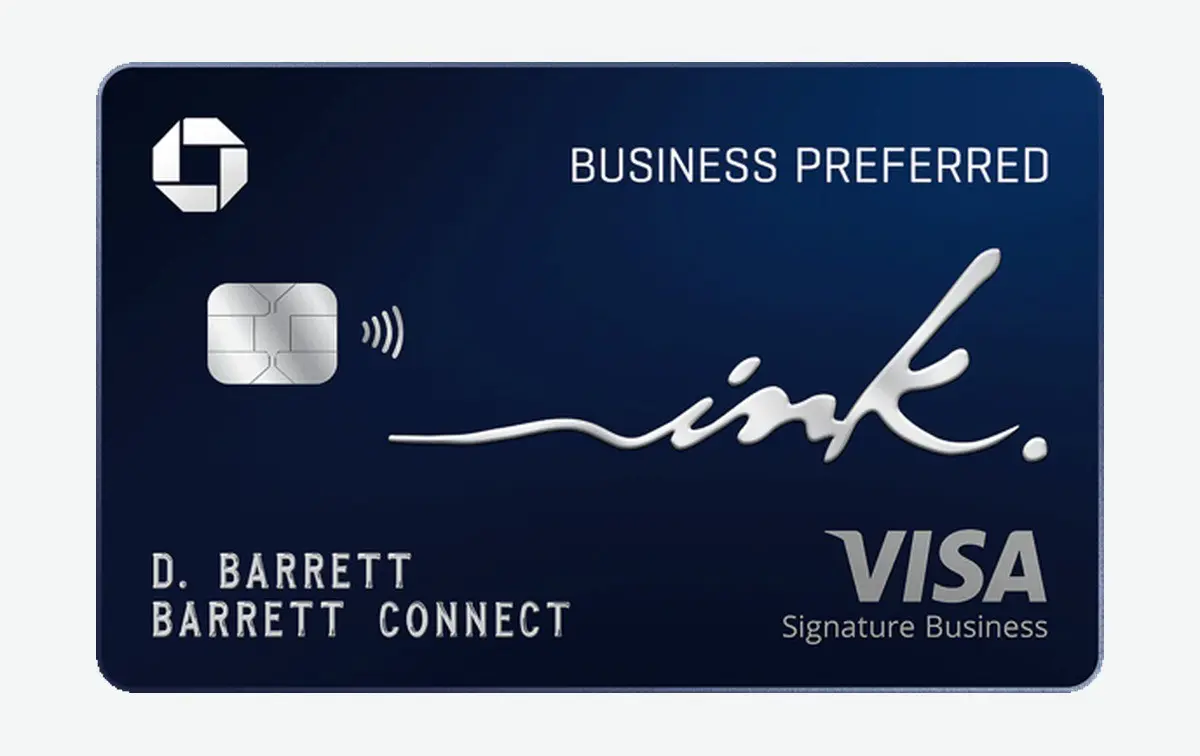
- Annual fee: $95
- Earn: 3X points on the first $150,000 spent in combined purchases each account anniversary year on shipping purchases; advertising purchases made with social media sites and search engines; internet, cable, and phone services; and travel. Then 1X.
- Advertising language is social media sites and search engines. It is not a blanket “anything marketing” bucket, so confirm how each vendor posts.
- Signup bonus (public offer on October 5, 2026): 100,000 bonus points after $8,000 in purchases in the first 3 months. May not be available if you have ever had this card. Offers vary.
- Foreign transaction fee: None
Source: Chase Ink Business Preferred product page.
Ink Business Cash

- Annual fee: $0
- 5% cash back on the first $25,000 spent in combined purchases at office supply stores and on internet, cable, and phone services each account anniversary year.
- 2% cash back on the first $25,000 spent in combined purchases at gas stations and restaurants each account anniversary year.
- 1% on all other purchases. That includes social and search advertising.
- Signup bonus (public offer on October 5, 2026): $750 cash back after $6,000 in purchases in the first 3 months. May not be available if you have ever had this card or any other Chase for Business card without an annual fee. Offers vary.
- Foreign transaction fee: 3% of each transaction in U.S. dollars, per Chase Pricing & Terms.
Source: Chase Ink Business Cash product page.
Ink Business Unlimited (contrast only)
When neither bonus structure fits, Chase’s $0-annual-fee Ink Business Unlimited earns a flat 1.5% cash back on every purchase. On ads that is still below Preferred’s 3X, but it is a reasonable catch-all for charges that do not fit either card’s categories. It is not a third pick on this page.
Bridge to the ads map, the Gold stack, and coding
- Ads routing detail: best business cards for ad spend
- Ads plus software, Preferred vs Amex Business Gold: Ink vs Amex Business Gold operator stack
- Confirm the posted category: how to tell what category a credit card charge coded
- Google Ads specifically: does Google Ads code as advertising?
Mini checklist: run a small or normal charge, wait until it posts, read the issuer’s category, compare it to Preferred’s advertising language or Cash’s office and telecom language, and re-route next cycle if it landed wrong.
We do not publish merchant-code tables. Read your own statement.
Issuer wording moves, so before you re-route a bill, check what changed on the map this month for dated changes to these cards.
Questions
Ink Preferred vs Ink Cash for Ads: which should pay advertising?
Ink Business Preferred. As of October 5, 2026, Preferred earns 3X on advertising purchases made with social media sites and search engines, inside a combined $150,000 anniversary-year basket. Ink Business Cash has no advertising bonus, so those charges earn its base 1%. Confirm how each vendor posts before you scale.
Does Ink Cash earn 5% on advertising?
No. Ink Business Cash’s 5% categories are office supply stores and internet, cable, and phone services, on the first $25,000 combined per account anniversary year. Advertising is not in that basket. Ads on Cash earn 1%.
What is Ink Cash’s 5% actually for?
Office supply stores plus internet, cable, and phone services, sharing one $25,000 combined anniversary-year cap. After that, base earn. Separately, Cash pays 2% at gas stations and restaurants on another $25,000 combined. None of that is an ads rate.
Should I hold both Ink Preferred and Ink Cash?
Yes when social or search ads are material and you also spend meaningfully in Cash’s office, telecom, gas, or dining baskets. Route ads to Preferred and Cash’s categories to Cash while under its caps. Skip Cash when those baskets are thin. Skip Preferred only when you have almost no social or search ad spend.
Does internet, cable, and phone earn more on Cash or Preferred?
Usually Cash, while you are under its $25,000 combined 5% cap with office supply. Cash’s 5% beats Preferred’s 3X on the same telecom bill until that cap fills. After that, Preferred’s 3X (inside its larger $150,000 basket) wins. This overlap is not an advertising rule.
When is Preferred’s $95 annual fee not worth it for ads?
When your social and search ad volume, plus other Preferred 3X spend you actually have, cannot clear the fee compared with a $0 flat card, or when your “ads” do not post as Chase advertising. Re-check Chase the day you decide. Categories and offers change.
For the wider picture, see the card map. Ads routing stays on the ad-spend map. Ads plus software stays on the Preferred vs Gold stack. Confirm coding with how to tell what category a charge coded. Methodology: How we compare. Independence: Disclosure.
Last updated: October 5, 2026
Byline: Credit Waypoint (Organization). Corrections: hello@creditwaypoint.com. Methodology: How we compare.